 SystemForge Software
AI Document Processing and OCR for Business: The 2026 Practical Guide
AI Document Processing and OCR for Business: The 2026 Practical Guide
AI document processing combines OCR (optical character recognition) with language models to extract, classify, and validate information from unstructured documents — invoices, contracts, medical records, expense reports, and forms. A business processing 500 documents/month manually spends 40-80 hours of staff time. Automated with AI, the same volume requires less than 2 hours of human review.
I'm Pedro Corgnati, founder of SystemForge and full-stack developer. I've implemented document processing pipelines for law firms, medical clinics, and distributors. The productivity gains are real and accessible for SMBs with the right approach.
Traditional OCR vs. AI-powered OCR: what's the actual difference
Traditional OCR (text recognition only)
Traditional OCR converts images of text into machine-readable text. It works well for standardized, well-formatted documents (fixed forms, driver's licenses, passports). Tools like Tesseract (open source) and ABBYY FineReader do this well.
Limitation: traditional OCR doesn't understand context — it extracts text but doesn't know that "$1,250.00" is the invoice total and not the line item subtotal.
AI-powered OCR (extract + interpret)
Modern multimodal models (GPT-4o, Claude 3.5, Gemini Vision) combine OCR with semantic understanding. You send the document image or PDF, and the model extracts specific fields, validates internal consistency, and automatically classifies the document type.
Real example: sending an invoice image to GPT-4o with the right prompt returns a structured JSON with: invoice number, vendor EIN/Tax ID, customer ID, date, subtotal, tax, total, line items with codes and quantities. Accuracy on clean digital invoices: 96-99%.
Most valuable use cases for SMBs in 2026
Invoice processing and AP automation
Distributors, retailers, and accounting firms receive dozens to hundreds of invoices daily — as PDFs, scanned paper, or emailed attachments. The automated pipeline: receives file via email/API → classifies as invoice, PO, or credit memo → extracts relevant fields → validates vendor tax ID via IRS TIN matching → posts to ERP/accounting system.
Manual time: 3-5 minutes per invoice. With AI: 15-30 seconds per invoice. For 300 invoices/month, that's 12-22 hours of staff time recovered monthly.
Contract review and risk identification
Legal departments and law firms use AI to extract key clauses from contracts: parties, governing law, payment terms, termination rights, liability caps, confidentiality obligations. The model identifies and summarizes high-risk clauses for priority human review.
Not a lawyer replacement — it's a pre-screening tool that reduces contract triage time by 60-70%. A small legal team that previously spent 3 hours reviewing a standard vendor agreement can now do it in 45 minutes.
Medical records and clinical documentation
Healthcare practices process patient records, lab results, and imaging reports in PDF format. AI extracts structured data (ICD codes, medications, allergies, lab values) and enters it into the electronic health record, eliminating manual transcription.
Compliance note: medical records contain PHI (Protected Health Information) subject to HIPAA. Processing must occur in a HIPAA-compliant environment with proper Business Associate Agreements with AI vendors. Check vendor compliance status before processing any PHI.
HR document processing
HR departments receive resumes in multiple formats (PDF, Word, image). AI extracts work history, education, skills, and contact info in a standardized format, enabling easier candidate comparison and ATS import. Also useful for I-9 verification document processing and employee onboarding paperwork.
Tools available in 2026
LLM APIs with vision capabilities
OpenAI GPT-4o: best cost-performance for structured extraction. Average cost: $0.004-0.015 per document depending on length and complexity. Direct support for PDFs and images.
Anthropic Claude 3.5 Sonnet: excellent for text-heavy documents and contract analysis. Similar cost to GPT-4o. Strong instruction-following for complex extraction schemas.
Google Gemini 1.5 Pro: native support for long PDFs (up to 1,000 pages). Best for annual reports and lengthy technical documents. $0.00125 per 1k input tokens.
Specialized document AI platforms
Docparser: low-code platform for PDF data extraction with visual templates. No coding required. From $39/month. Good for businesses without a dev team.
Nanonets: specialized in invoice and financial document automation. Custom model training on your document types. From $199/month.
AWS Textract: robust OCR from AWS with form and table extraction. $0.015/page for text, $0.065/page for forms and tables. Best if you're already on AWS.
Azure Document Intelligence: Microsoft's alternative, strong M365 integration. Similar pricing to Textract. Pre-built models for invoices, receipts, and tax documents.
Open-source options
PaddleOCR: open-source OCR with better accuracy than Tesseract on complex formatting. Free, requires your own server. Supports English and many other languages well.
Docling (IBM): open-source document extractor with structure preservation (tables, headers, captions). Free, excellent for technical documents and reports.
Implementation architecture: building a document pipeline
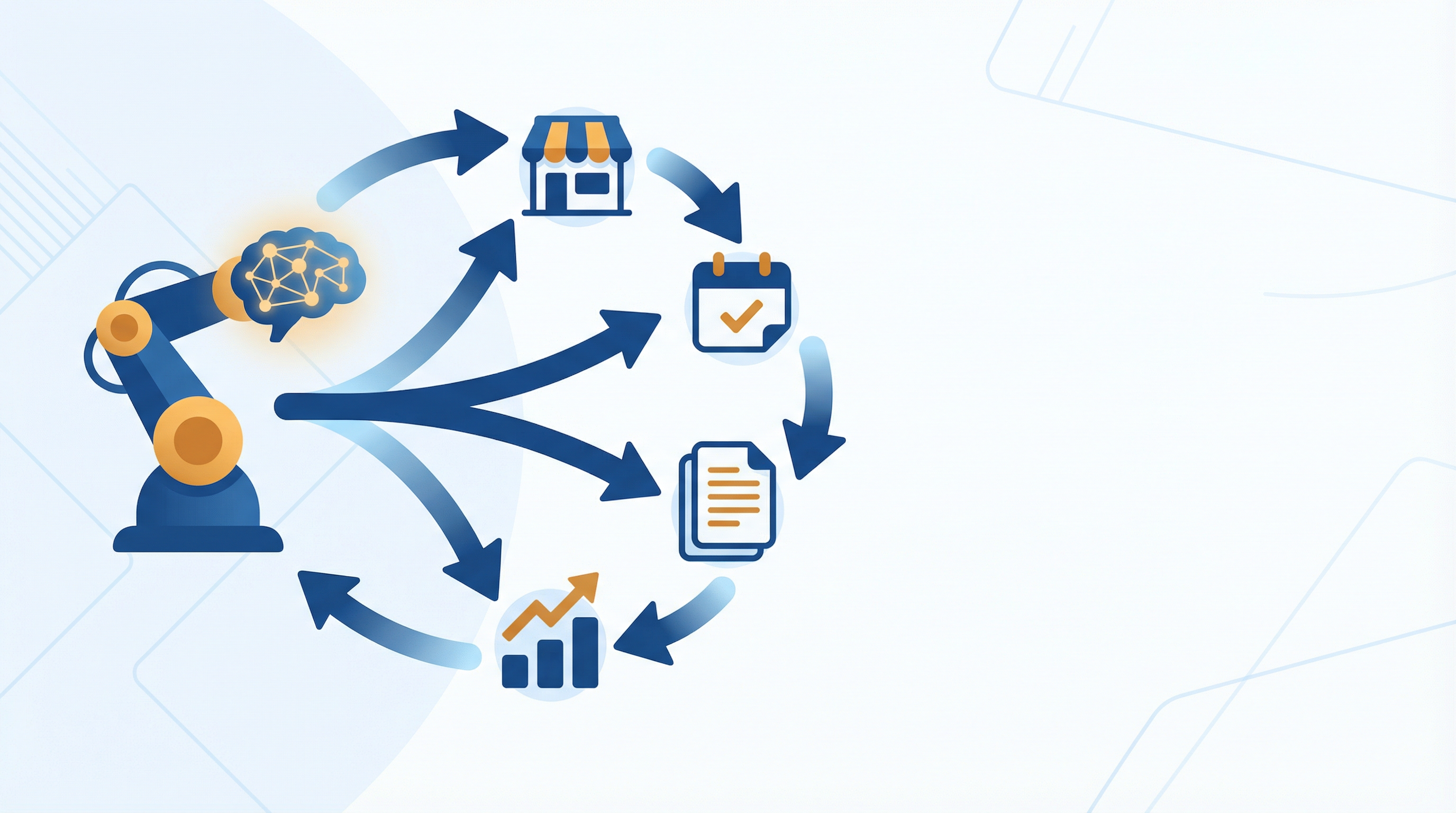
A typical document processing pipeline for an SMB:
- Ingestion: receives documents via email, web upload, or API (webhook from your DMS)
- Pre-processing: converts to standard format, corrects orientation, enhances image quality
- OCR + extraction: sends to LLM with structured prompt, receives JSON with extracted fields
- Validation: checks required fields, validates tax IDs, confirms internal consistency (line items sum to total, etc.)
- Human review queue: low-confidence documents routed for human verification
- Integration: posts data to ERP/accounting via API
- Archival: stores original document with extracted metadata for audit trail
Implementation cost for a basic SMB pipeline: $10,000-30,000 for custom development, or $200-600/month using platforms like Docparser or Nanonets.
For more on business process automation, see business automation for SMBs and AI agents for small business. If your company handles a high volume of contracts, read advanced dashboard filters for business intelligence for how to build internal review tools.
Frequently Asked Questions
What's the accuracy of AI-powered OCR on business documents?
For clean digital PDFs (system-generated), accuracy reaches 97-99%. For photos of physical documents with good lighting, 90-95%. For handwritten documents, 70-85%. Human review of low-confidence outputs is always recommended for critical processes.
Is AI document processing compliant with data privacy regulations?
Yes, when implemented correctly: processing on servers with a Data Processing Agreement (DPA) with the AI vendor, encryption in transit and at rest, role-based access control, and audit logging. PHI under HIPAA requires HIPAA Business Associate Agreements. PII under GDPR/CCPA requires appropriate data processing controls.
Do I need a technical team to implement this?
For low-code platforms (Docparser, Nanonets), not necessarily — a business analyst can configure it. For custom pipelines integrated with your ERP, yes — you'll need a developer experienced with APIs and automation. Development costs range from $8,000 to $30,000 depending on complexity.
What's the typical financial ROI?
For businesses processing 200+ documents/month manually, average ROI is 4-8 months. Savings come from reduced data entry hours, elimination of data entry errors (which generate costly corrections), and faster document turnaround (urgent documents processed in seconds, not hours).
Can I process confidential documents with third-party AI APIs?
Check the vendor's data usage terms first. OpenAI, Anthropic, and Google do not use data submitted via API to train their models (unlike free web interfaces). For highly confidential documents (M&A materials, attorney-client privileged documents, clinical trial data), consider running models locally (Mistral, LLaMA 3) or in your own cloud infrastructure.
How accurate is AI for handwritten documents?
Handwriting is the hardest challenge. Modern vision models achieve 70-85% accuracy on clear handwriting in structured forms (where context helps interpret ambiguous characters). Fully free-form handwriting is 60-75% accurate. For high volumes of handwritten documents, models can be fine-tuned on your specific document types to improve accuracy to 85-92%.
Conclusion
AI document processing isn't a future technology — it's working in production at businesses of all sizes today. The combination of LLM APIs with automation pipelines dramatically reduces manual data entry work with payback measured in months. The simplest starting point: pick one document type you process frequently (invoices, for example), measure your current manual processing time, and calculate what automating it would cost and save.
Want to implement automated document processing in your business? Talk to an expert — we'll assess your use case and estimate the return.
Updated April 2026
Want to Automate with AI?
We implement AI and automation solutions for businesses of all sizes.
Learn more →Need help?