 SystemForge Software
AI Agents: What They Are and When to Use Them
There's a lot of hype around "AI agents." Every week a new framework appears promising that you'll build an autonomous agent that solves any problem. In practice, most implementations called "agents" are chatbots with RAG and a couple of extra functions. And that's not necessarily bad — sometimes that's exactly what you need.
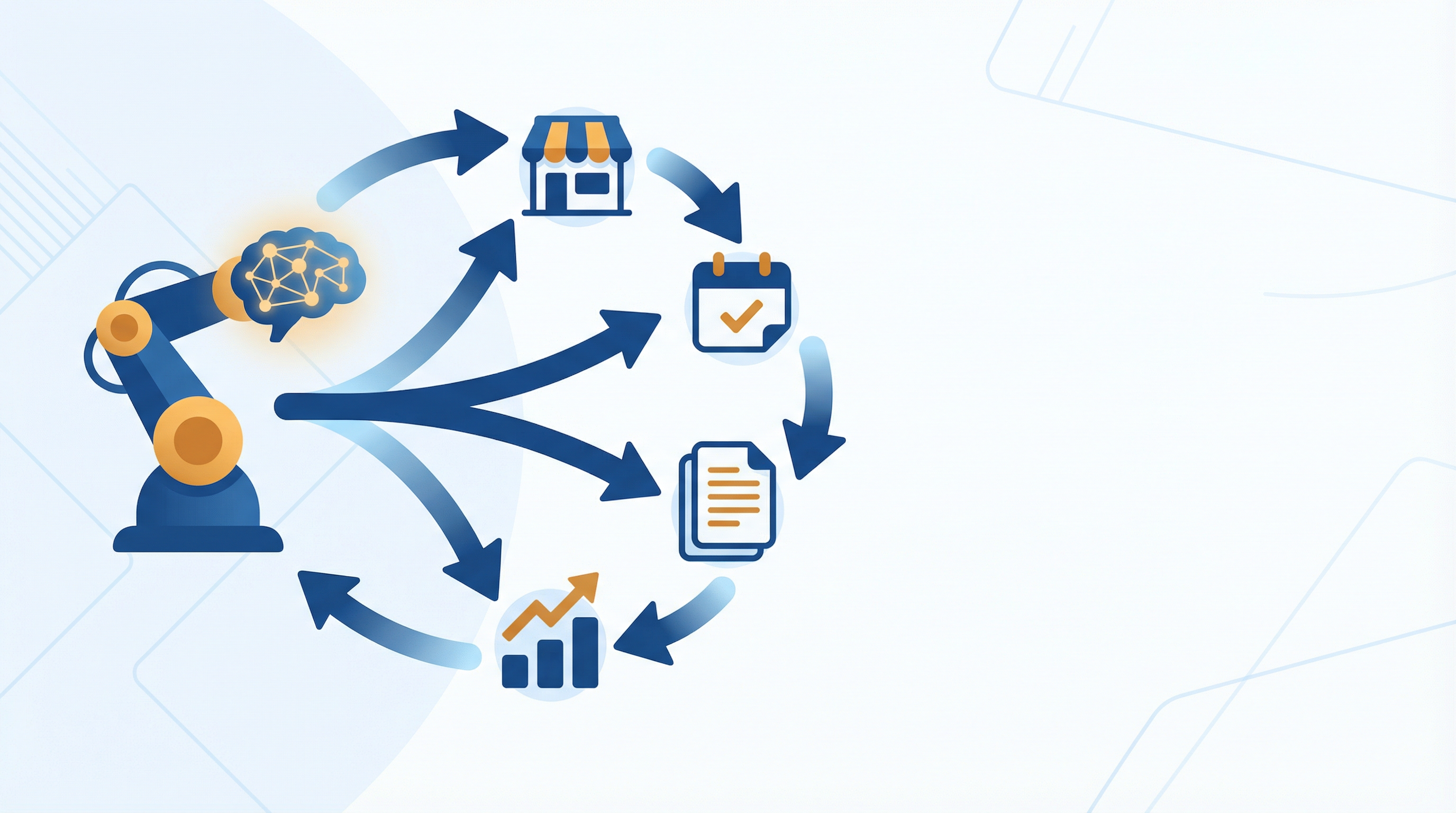
But when a real AI agent makes sense, it can automate workflows that previously required hundreds of human hours per month. The difference lies in understanding what makes a system genuinely agentic — and the risks that come with it.
What Makes a System Agentic
A traditional chatbot follows a flow: receives input, processes it, returns output. Each interaction is independent. An agent is different in three dimensions:
Planning: the agent decomposes an objective into subtasks. Given the goal "do a competitive analysis of company X," the agent plans which searches to run, which data to collect, how to structure the report — before executing any step.
Tool use: the agent has access to functions that perform actions in the real world — web search, code execution, file reading, API calls, sending emails.
Memory and loop: the agent maintains state between steps. The result of one action informs the next. It keeps executing until it reaches the objective or hits a blocker.
The practical distinction: a chatbot answers questions. An agent executes tasks.
Tool Use: How Agents Interact with the Real World
Tool use is the mechanism that gives the agent the ability to act beyond generating text. OpenAI calls it "function calling"; Anthropic calls it "tool use." The concept is the same: you define functions with a name, description, and expected parameters, and the model decides when and how to call each one.
import json
from openai import OpenAI

client = OpenAI()

# Define available tools
tools = [
    {
        "type": "function",
        "function": {
            "name": "get_product_price",
            "description": "Gets the current price of a product from the inventory system",
            "parameters": {
                "type": "object",
                "properties": {
                    "product_code": {
                        "type": "string",
                        "description": "Product SKU code"
                    }
                },
                "required": ["product_code"]
            }
        }
    },
    {
        "type": "function",
        "function": {
            "name": "create_order",
            "description": "Creates a new order in the system",
            "parameters": {
                "type": "object",
                "properties": {
                    "product_code": {"type": "string"},
                    "quantity": {"type": "integer"},
                    "customer_id": {"type": "string"}
                },
                "required": ["product_code", "quantity", "customer_id"]
            }
        }
    }
]

def execute_tool(name: str, args: dict) -> str:
    if name == "get_product_price":
        # This would call the real system
        return json.dumps({"price": 149.90, "stock": 23})
    elif name == "create_order":
        return json.dumps({"order_id": "ORD-001234", "status": "confirmed"})

# Agent loop
messages = [{"role": "user", "content": "Create an order for 2 units of product SKU-789 for customer C-001"}]

while True:
    response = client.chat.completions.create(
        model="gpt-4o",
        messages=messages,
        tools=tools,
    )

    msg = response.choices[0].message
    messages.append(msg)

    if msg.tool_calls:
        for call in msg.tool_calls:
            result = execute_tool(call.function.name, json.loads(call.function.arguments))
            messages.append({
                "role": "tool",
                "tool_call_id": call.id,
                "content": result
            })
    else:
        print(msg.content)
        break
The model decides when to call each tool based on the conversation. This enables multi-step flows where the agent gathers information before executing actions.
ReAct and Chain-of-Thought: Structured Reasoning
ReAct (Reasoning + Acting) is a prompting pattern that instructs the model to explicitly alternate between reasoning and action. Instead of simply calling tools, the model "thinks out loud" before each step:
Thought: The user wants to create an order. First I need to check the price and stock.
Action: get_product_price(product_code="SKU-789")
Observation: {"price": 149.90, "stock": 23}

Thought: The product is available. Now I can create the order.
Action: create_order(product_code="SKU-789", quantity=2, customer_id="C-001")
Observation: {"order_id": "ORD-001234", "status": "confirmed"}

Thought: The order was created successfully. I can inform the user.
Final answer: Order ORD-001234 created successfully. 2 units of product SKU-789...
This explicit reasoning has two advantages: the model makes fewer mistakes by breaking problems into smaller steps, and you have traceability of what the agent was "thinking" when it made each decision.
Risks: When Agents Make Wrong Decisions
Autonomous agents amplify both successes and failures. An agent with access to email, a database, and an order system can process 1,000 transactions per hour without human intervention — and can also send 1,000 emails with incorrect information or create 1,000 incorrect orders.
The main production risks:
| Risk | Description | Mitigation |
|---|---|---|
| Prompt injection | Malicious inputs that hijack the agent's behavior | Validate and sanitize all external inputs |
| Irreversible actions | Deleting data, sending communications, charging amounts | Require human confirmation for irreversible actions |
| Infinite loop | Agent enters a cycle of actions without progressing | Iteration limit and timeout per task |
| Excessive permission scope | Agent has access to more than it needs | Principle of least privilege for tools |
| Uncontrolled cost | Agent makes hundreds of LLM calls for a simple task | Cost limit per session |
The most important rule: don't give an agent access to actions you wouldn't be comfortable seeing executed automatically 1,000 times in a row.
For critical systems, the "human-in-the-loop" pattern — where the agent plans the actions and a human approves them before execution — balances automation with control.
Conclusion
AI agents represent a real shift in process automation. Tasks that require multiple steps, intermediate decisions, and interaction with external systems are the natural territory of agents. But building reliable agents requires discipline: well-defined tools, structured reasoning, and explicit safeguards.
The hype around autonomous agents often ignores the operational risks. At SystemForge, we build agentic systems with robust guardrails — automation you can supervise and trust. If you have repetitive processes that could be automated with AI, reach out to assess whether and how agents can help.
Want to Automate with AI?
We implement AI and automation solutions for businesses of all sizes.
Learn more →Need help?